

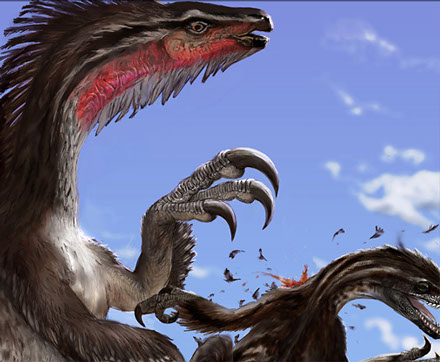


Nothronychus graffami was a pudgy 1-ton dinosaur that stomped across North America 93 million years ago. Though probably a slow-moving herbivore, its giant hooklike claws, long as sickles, would have made it a match for the fast raptorlike predators of the time; in this original piece for the Museum of Northern Arizona, an adult swats away a leaping attacker with bloody results (art © Victor O. Leshyk).
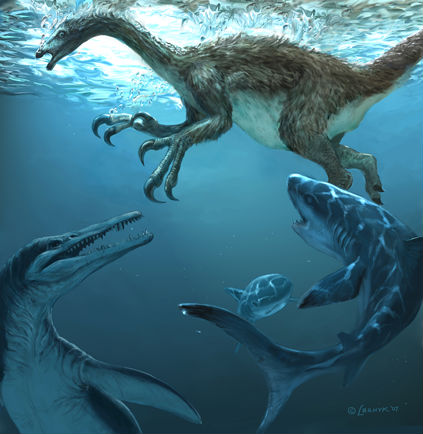
I had the good fortune to create the first illustrations of the most complete Therizinosaur specimen found in North America, discovered in a fossil seafloor, among bones of marine predators and giant fish in the Utah desert. One theory posits that the 1-ton land animal may have been washed out to sea alive, fending off circling scavengers until exhaustion sank it straight to a muddy grave (art © Victor O. Leshyk).
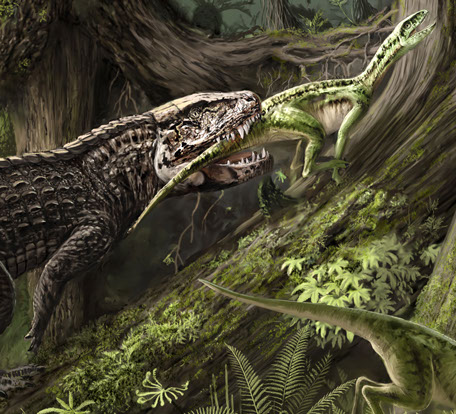
Before dinosaurs "ruled the earth," there were equally fearsome animals taking care of business in many similar ways. The powerful Postosuchus was a top predator of the Triassic Petrified Forest of Arizona that evolved the heavy jaws and strong running legs reminiscent of later large dinosaurs, but went extinct with no descendants while dinosaurs grew in size and variety. It is shown here running down several Silesaurs, speedy deerlike herbivores (but also not dinosaurs). Detail from my new wall-sized mural at the Rainbow Forest Museum, Petrified Forest National Park (art © Victor O. Leshyk)
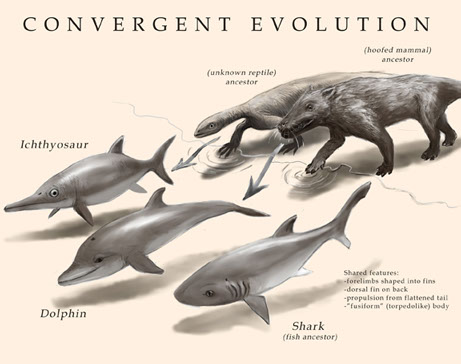
Convergent evolution arises when organisms of completely separate ancestries evolve similar solutions of body form and function over time in response to similar life pressures. This phenomenon really shows off the amazing plasticity (and yet also a conservatism) of the vertebrate form; in my illustrated example above, slow pressures to optimize bodily movement in water have sculpted true fish, hairy hoof-footed mammals, and waddling reptiles into almost indistinguishable sleek, finned, torpedo-shaped bodyforms, which converge due to exploiting the physics of hydrodynamics in similar efficient ways.
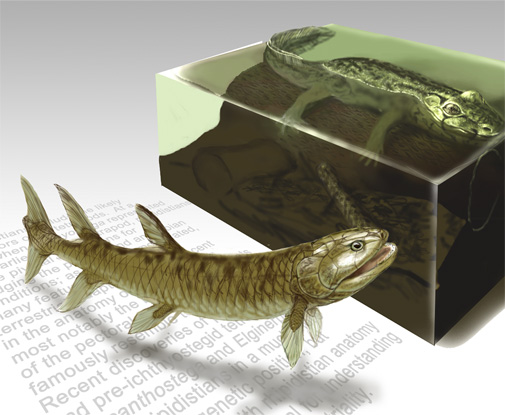
The vertebrate transition from freshwater to land is a hot topic lately, with many new fossil discoveries adding a spectrum of early tetrapods to the previous fossil gap between fish and amphibian. Shown here is the early air-breathing, lobe-finned fish Eusthenopteron ("good strong fin") whose skull and fleshy fin-bases shared a design plan with the bodies of the later four-limbed creatures that ventured far ashore (art © Victor O. Leshyk).
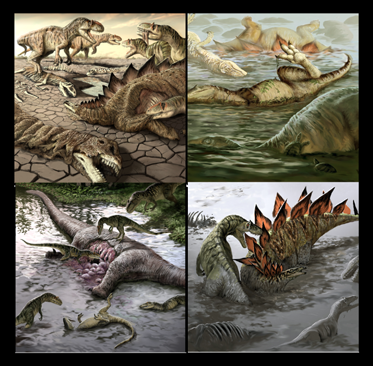
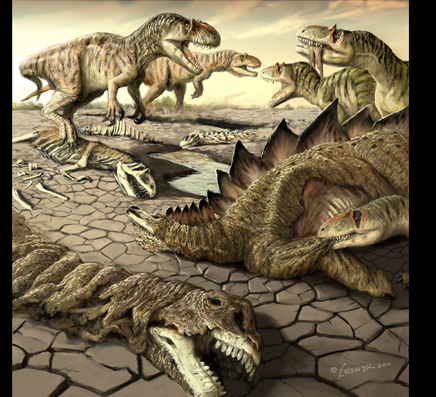
Drought, Flood, Poison, and Mud---the four main theories I illustrated to explain the deaths of so many dinosaurs at the Cleveland-Lloyd dinosaur quarry. Currently on display as part of the Past Worlds gallery of the Natural History Museum of Utah (art © Victor O. Leshyk).
Drought can create a type of "predator trap" that fossilizes. As waterholes shrink, animals congregate around the last wet areas, and predators take down the weak, whose bones accumulate. However, if hard times continue, predators perish too as they starve or fall upon each other. Closer view of the Cleveland-Lloyd dinosaur quarry illustration created for the Rio Tinto Center at NHMU (art © Victor O. Leshyk)
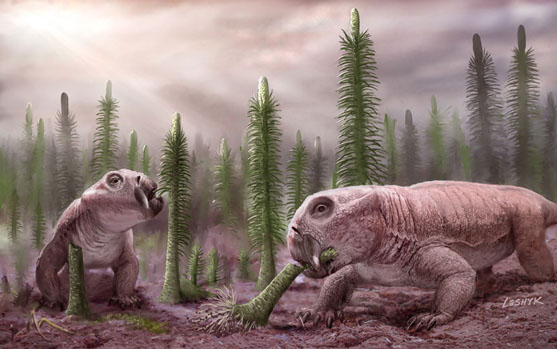
The Permian Extinction (~253 million years ago) was the worst disaster of all time, with 95% of all species going extinct as the planet was wracked a global "perfect storm" of massive volcanoes and climate change, with widespread drought, soaring greenhouse-effect heat and dead, stagnant oceans. When these crises calmed, the few survivors had a barren world to themselves; for the next few millions of years, the pig-sized mammal relative Lystrosaurus and strange bottle-brush plant Pleuromeia filled up monotonous landscapes across many continents until new ecosystems evolved from the other, less-populous survivors who had also squeaked through the extinction (art © Victor O. Leshyk).
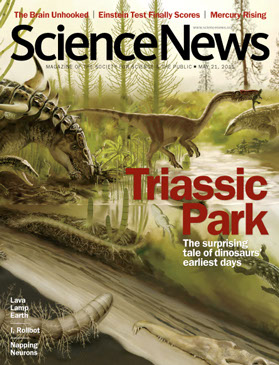
ScienceNews featured my new Triassic mural artwork (see also Petrified Forest under "Exhibits" on this site) in their excellent cover story introducing new finds which flesh out the origins and lives of the first dinosaurs
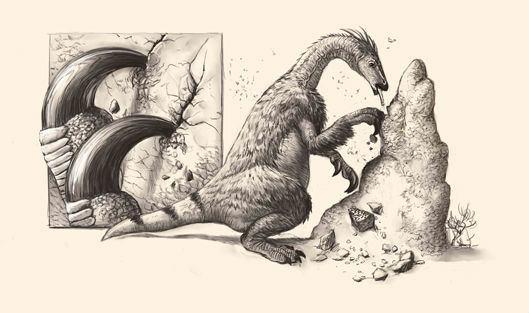
An early theory guessed that therizinosaurs may have used their curving claws to pry open termite mounds to feed. However, there are no good animal models today to substantiate such a large creature making a living by specializing on termites.
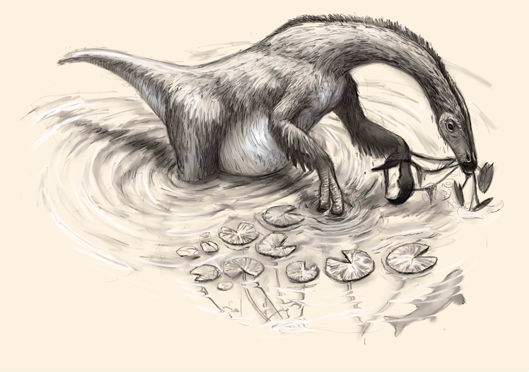
Among the possible lifestyles for large therizinosaurs: wading browsers of waterplants, with the large claws used as gathering-hooks. Water lilies made their evolutionary debut around the same time, and were probably as edible and nutritious as animals find them today.
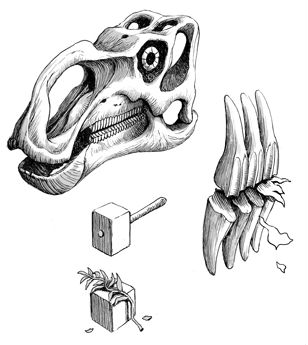
This piece I created for the Natural History Museum of Utah details the highly-specialized "tooth batteries" of duckbilled-dinosaurs; a specially jointed jaw flexed so as to make the dense arrays of teeth shear efficiently past one another, shredding and mashing at the same time. In life, fleshy cheeks contained each mouthful of leaves and twigs as it was minced finer and finer.
<
>