


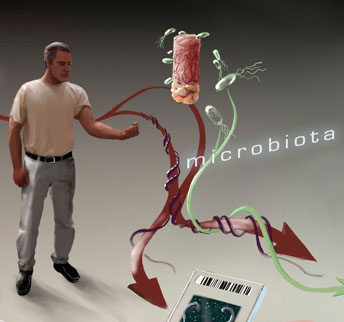






METAGENOMICS studies mixed samples of DNA extracted / recovered from a shared environment, such as soil, seawater, or even the microscopic zoo on the landscape of the human body to identify the kinds of players that are present on the stage. And with the recent advances in high-throughput DNA sequencing, metagenomics can be increasingly used to characterize the human microbiome of both normal and pathogenic flora to better understand disease states. In this detail from my work for the journal Genome Research, a man is about to meet the Pseudomonas bacteria of his antecubital fossa (green flagellated cells) once the column of tissue in his skin punch biopsy (not to scale at all) is analyzed. Part of a complex special poster sponsored by Roche: to see the whole beautiful thing, visit the Genome Research site here.
Another detail from the special 2009 "Personal Genomes" poster I created for the journal Genome Research and sponsored by Roche. In this close-up of a high-throughput DNA sequencing methodology using pyrosequencing, a short single-strand sample from a cloned DNA library is bound to a polymer bead at left, outfitted with a primer sequence so that it can be copied while bound; the membrane-looking sphere is a water microdroplet that serves as a tiny reactor vessel in which the sample strand is then amplified by PCR reagents so that the bead is studded with copies of the same sample. The whole sample's variety of studded beads is then spread onto a patented plate / chip honeycombed with wells of only a few picoliters each; each well seats one bead and added reagents (including DNA polymerases). When the filled wells are washed with a wave of one specified nucleotide at a time (in this example, "A"), the provided reagents add the base only if it is the next in the exposed strand's sequence; if this is so, the well contents will react with the freed phosphate group to produce a flash of greenish fluorescence (the "pyro" of pyrosequencing). A CCD camera placed over the plate records the exact position of each flash paired with each choice of nucleobase for each well, and thereby builds up the short sequence of each well's strand, which is then compiled with all others by computer as a series of overlapping short-reads, to be finally summed to a single master sequence for the sample.
What is the point of Personal Genomics? The poster composition culminates in a "magic mirror" at the bottom before which the subject / patient stands, with explicating Genomic Counselor at his side. At center, the shifting stacks of summed genomic databases that loom behind converge to present a genomic portrait of the subject, an ever-updating profile that unifies what is known and understood of the individual's personal sequence. In the end, genomics can provide this comprehensive view, helping to predict and treat personal disease (the left mirror pane, "Therapy," showing a real "miracle" anticancer drug (imatinib) that was designed based on genetic understanding), trace personal ancestry through a worldwide human family (the right-hand pane), and more broadly lets one "Gnothi Sauton" (the Greek phrase over the central pane, which was also inscribed over the door to the famous Oracle of Delphi), meaning "know thyself," the same offer made silently by every mirror one visits.
What is the point of Personal Genomics? The poster composition culminates in a "magic mirror" at the bottom before which the subject / patient stands, with explicating Genomic Counselor at his side. At center, the shifting stacks of summed genomic databases that loom behind converge to present a genomic portrait of the subject, an ever-updating profile that unifies what is known and understood of the individual's personal sequence. In the end, genomics can provide this comprehensive view, helping to predict and treat personal disease (the left mirror pane, "Therapy," showing a real "miracle" anticancer drug (imatinib) that was designed based on genetic understanding), trace personal ancestry through a worldwide human family (the right-hand pane), and more broadly lets one "Gnothi Sauton" (the Greek phrase over the central pane, which was also inscribed over the door to the famous Oracle of Delphi), meaning "know thyself," the same offer made silently by every mirror one visits.
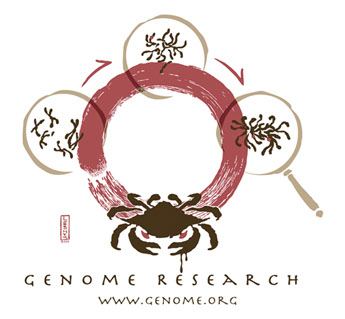
Cover art for a special Cancer Genomics issue of Genome Research. Based on the Zen meditation practice in which the practitioner paints an "enso" (Japanese; literally "circle") each day as a single brush stroke as an exercise in focus, natural wholeness, and renewal. In this context, however, the process represents the repeating cell cycle (overlain by enso-like nuclei with chromosomes), which carcinogenesis "redraws" in stages (through accumulating mutations, shown as red dots) until the cell is another thing entirely (bottom), with seeming mind and agenda of its own.
Illustrated design produced as a special Cancer Genomics conference T-shirt for the journal Genome Research. Based on the Zen meditation practice in which the practitioner paints an "enso" (Japanese; literally "circle") each day as a single brush stroke as an exercise in focus, natural wholeness, and renewal. In this context, however, the process represents the repeating cell cycle (overlain by enso-like nuclei with chromosomes), which carcinogenesis "redraws" in stages (through accumulating mutations, shown as red dots) until the cell is another thing entirely (bottom), with seeming mind and agenda of its own. Cancer Genomics seeks to understand the process (magnifying lens at right).
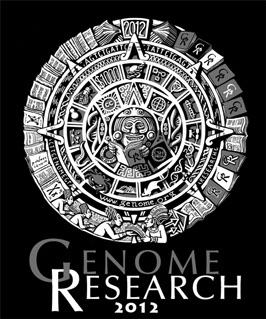
Illustrated design produced as a special conference T-shirt for the journal Genome Research in defiance of the then-predicted end of the world in 2012. Features a genomic-research version of the famous apocalypse-talisman itself, the Mayan Calendar, complete with its own cosmology (see next slide for details).
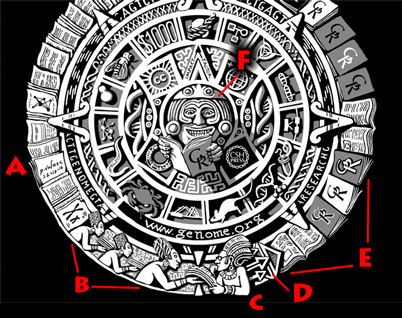
Closer view of the special illustrated T-shirt for the journal Genome Research, made in preparation for the 2012 non-apocalypse. Design iconography gives an allegorical portrait of the publishing process:
"Generating a stream of writings (a) through endless study and research, Supplicants (B) present offerings for priestly review (c) ; those writings deemed worthy (d) are added to the journal cycle (e), which, through the twelve publishing months, feeds the great Reader (f, center) the best of offerings to date. Ever-evolving rings of Topics thereby surround the Reader, and shift and change with the growing Field. At top, the date 2012 represents the year in which all readers shall attain “Enclothement” ---the option of a t-Shirt to commemorate the great cycle, which will start its endless roll again, for the benefit of all, the following year--"
<
>