


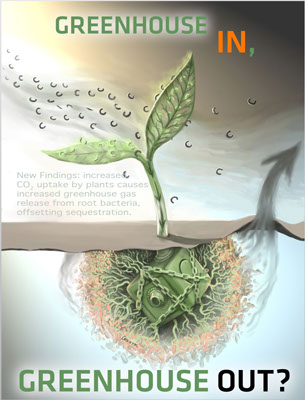


Press Release Illustration: new research shows that increased CO2 levels in the environment actually fuel further greenhouse gas emissions from root bacteria--the faster-growing plants "leak" more free sugars from roots, feeding soil bacteria metabolism which exhales methane and other gases.
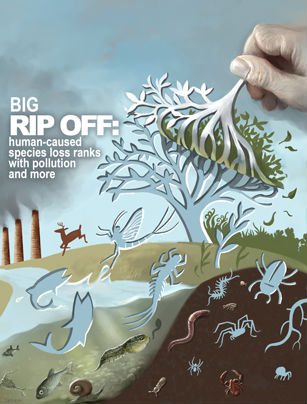
Press Release Illustration to accompany new research that quantifies the environmental impact of human-induced losses to biodiversity.
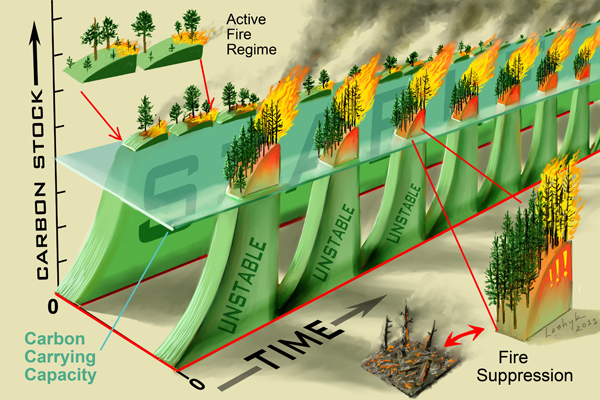
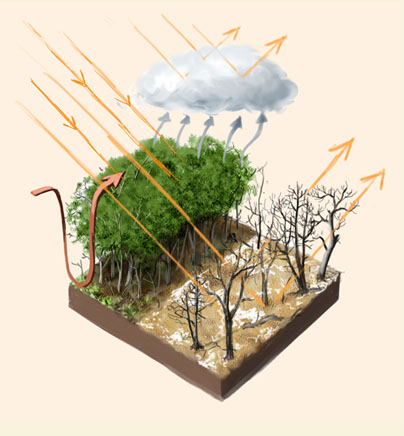
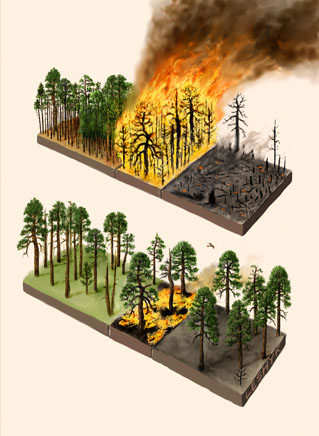
Book Chapter illustration: graphic to dramatize the threats posed by overstocked forest. Policies that prohibit thinning or controlled burns set the stage for large losses in Carbon stock due to catastrophic wildfires; thinner forests maintain a larger, more stable carbon stock over time. Research by Hurteau et al.
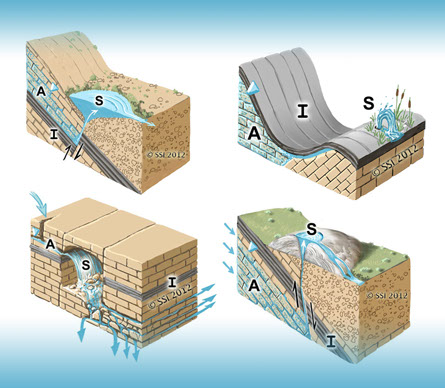
Being able to reliably identify unique habitats is crucial to protecting their resident biodiversity; my illustrations for a new guide to natural springs presented several new forms identified by the authors and created a formal nomenclature for springs worldwide as targets for research and conservation. Visit the Springs Studies Institute here.
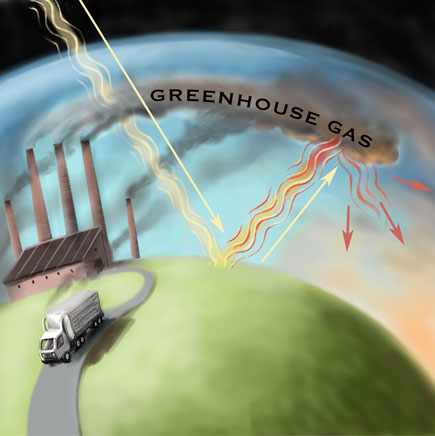
Illustration of re-radiated heat trapped by greenhouse gases. Created for Dept. of Energy-affiliated NICCR Western Region website.
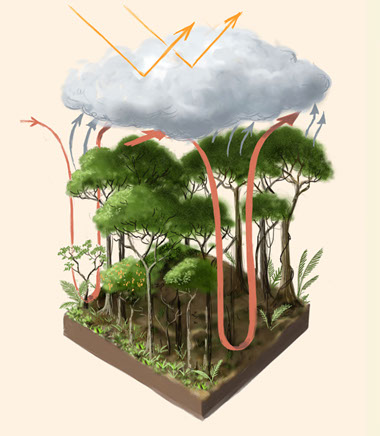
Illustration of "Roughness" (red vector) alongside factors of albedo and latent heat for a storied tropical forest.
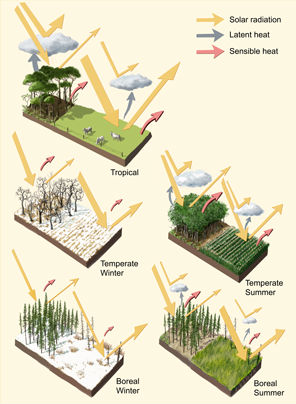
Illustration for peer-reviewed research depicting the varying balance of solar gain, heat transfer, and reflectance due to albedo depending on season and landscape.
Figure for peer-reviewed research depicting roughness, albedo, and latent heat for summer vs. winter temperate forest.
Illustrated comparison of overstocked vs. thinned / managed forest in the face of spontaneous wildfire. The overstocked forest at top shows the typical / so-called "dog hair" density of small-diameter trees in a management scenario where all fires are suppressed and no thinning is carried out; this dense stock of fuel fosters "catastrophic" or "stand-replacing" wildfires as the flames spread easily through the crowns and canopy. The aftermath reveals a total destruction of the landscape.
By contrast, the managed forest at bottom re-creates the pre-settlement structure of larger, widely-spaced old growth trees with grassy meadows throughout; wildfires cannot easily spread through crowns, so wildfire exists as much lower-intensity "ground fires" which do not damage larger trees, preserving forest.
<
>